
Solar panels and air conditioning - can you run cooling off panels
Can UK solar panels run an air conditioning unit? The honest answer with real numbers on generation, consumption, and the battery question.
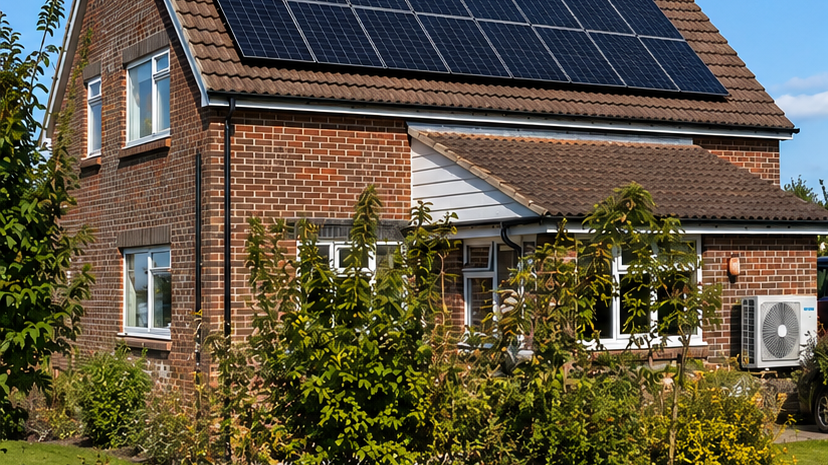
Air conditioning runs on electricity. Solar panels generate electricity. The two should pair perfectly. Reality is more nuanced - here are the honest numbers.
The daily maths
A typical UK 4 kWp solar system generates:
- June to August: 18 to 25 kWh per day
- September to October: 10 to 15 kWh per day
- November to February: 3 to 8 kWh per day
- March to May: 12 to 18 kWh per day
A 2.5 kW split system running for 6 hours on cool mode uses:
- Hot day (30 degrees outside): 6 to 8 kWh
- Mild day (24 degrees outside): 3 to 4 kWh
The good news
On a typical UK summer afternoon - when the sun is at peak generation AND when you want the air conditioning running hardest - a solar system delivers more than enough power to run the unit for free.
Household with 4 kWp solar plus one 2.5 kW split running 4pm to 10pm on a hot day:
- Solar generation from noon to 5pm: 12 to 15 kWh
- Air con consumption from 4pm to 10pm: 5 to 7 kWh
- Home baseline consumption during the day: 2 to 3 kWh
- Net: roughly break-even on the running cost of the air con
Free summer cooling. Real number, achievable.
The bad news
Solar generation peaks at midday. Air conditioning demand peaks at 6pm to 9pm. There is a mismatch.
Without a battery, any solar not used at midday gets exported back to the grid at 6-8p per kWh (Smart Export Guarantee). Then at 6pm when the compressor is running hard, you pull from the grid at 24-28p per kWh.
Effect: you get about 40 to 60% of the theoretical solar offset without a battery.
The battery question
A home battery (5 to 10 kWh capacity, £4,000 to £8,000 installed) closes the gap. Excess solar from midday charges the battery, which then discharges to run the air conditioning from 6pm.
Effect: 80 to 90% of the theoretical offset. Almost fully solar-powered cooling on a sunny day.
Payback maths for the battery:
- Saved import electricity: 6 to 12 kWh per day at 24p across 90 summer days = £130 to £260
- Saved import electricity from winter heating (air con used for shoulder-season heating): 4 to 8 kWh per day at 24p across 100 shoulder-season days = £96 to £192
- Total annual saving: £225 to £450
Battery payback on cooling alone: 15 to 25 years. On combined cooling and heating benefit: 8 to 12 years. Batteries last 10 to 12 years.
The numbers do not quite work on the pure economic case. They work if you value the resilience and the environmental angle.
What we would actually recommend
Three household scenarios:
Already have solar, no battery: fit the air conditioning. You get 40 to 60% of the solar offset. Genuinely free daytime cooling when the sun is out.
Already have solar plus battery: fit the air conditioning. You get 80 to 90% of the offset. Free summer cooling for a decade.
No solar yet: consider both together. Fit solar and air conditioning as a package. Solar install £5,500 to £8,000 for 4 kWp, air con £2,000 to £2,500. Combined install teams can share scaffolding costs.
The winter case
Solar generation drops sharply from November to February. Air conditioning on heat mode still runs, but the compressor draws from the grid.
Winter heating from air con at UK winter electricity prices: 20 to 30p per hour. Not solar-powered, but still cheaper than gas central heating for a single room.
The export tariff angle
If your Smart Export Guarantee tariff pays 15p+ per kWh (some do in 2026), the maths shifts. Excess solar exported at 15p is nearly as valuable as consumed at 24p, so the mismatch between solar peak and air con peak matters less.
Check your tariff. If you export at 8p and import at 24p, a battery makes sense. If you export at 15p and import at 24p, the case for a battery is weaker.
What to ask the installer
If you have solar or plan to, mention it in the air con enquiry. Two things a good installer will do:
- Check your consumer unit has capacity for the air con circuit without overloading the solar diverter or battery inverter.
- Recommend a schedule that runs the air con during peak solar generation, if your usage pattern allows.
Get three quotes with solar in mind
Fill in the quote form and mention “solar” in the comments. Installers will factor the electrical setup into the quote. Three fixed prices back within 24 hours.
Or check the prices page for a rough bracket first.
Ready for a real quote?
Get up to 3 fixed prices from vetted North West installers.
More on Guides
Air conditioning for a garden room or garden office
Garden rooms cook in August and freeze by November. One split system handles both jobs. How to size it, what the electrics need, where the condenser goes, and what a garden room install costs in 2026.
Air conditioning in a flat: what leaseholders need to know
Flats overheat worse than houses and carry the tightest rules on fitting cooling. Here is what your lease says, where the condenser can go, what freeholder consent costs, and the options when there is no outdoor space at all.
What temperature should you set your air conditioning?
Setting 16C does not cool a room any faster, and it costs you for the privilege. Here is the setpoint that works in a UK summer, what each degree adds to the bill, and when dry mode beats cool mode.